

Components manufactured by us are sourced from best quality raw materials sourced after thorough quality checking. All manufacturing processes are well scheduled with stringent pre- and post-manufacturing QC for any defects or deviations. Products offered by us are meant to last and work without any flaw.
Items that are not manufactured by us, like Membranes, FRP Housings etc. are sourced from the most renowned manufacturers across the globe.

CLARIFIERS
For Water Treatment
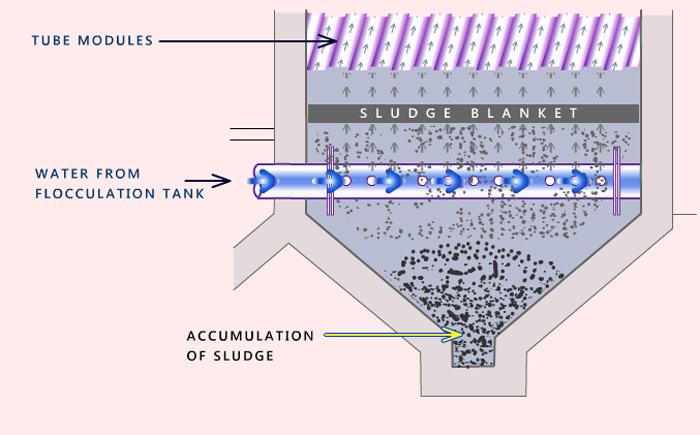
Used for removing Turbdity from river/ other surface water. The clarifier construction could be fully RCC (Reinforced Cement Concrete) or RCC-Mild Steel composite. For very small sized plants, complete Mild Steel construction is suggested.
Clarifiers could be Conventional or Lamella type. Lamella type clarifiers are equipped with Modular Tube Settlers in the clarification zone. An electrically operated Scrapper Bridge is standard for these both type of clarifiers. Separate Sludge Ejection mechanism remains attached at the bottom of clarifiers.

For clarification of wastewater, depending on the end use type, circular or rectangular shaped clarifiers are chosen. Circular clarifiers may or may not have an electrically operated Scrapper Bridge. However, Rectangular shaped clarifiers are devoid of any moving parts inside, and solely works on Sludge Blanket Principle for clarification.
VESSELS
Pressurized and Storage vessels are built with quality and certified steel and pipes. Our in-house welding and fabrication facilities meet the highest standard. We specialize in double-decker filters which meet higher filtering efficiency standards vis-a-vis smaller footprints. Quality of vessel fabrications are ensured by stringent Quality Control and various non-destructive tests.

Pressurised Vessels
All sorts of filters and softeners that operate under pressure are being manufactured with special care. Start from sourcing right material, quality welding technology to competent manpower to achieve finest workmanship – the entire cycle of production goes through stringent quality monitoring. All pressurised vessels manufactured are being tested at 1.5 times the actual operating pressure before dispatch.
Vessels are being manufactured as per IS & ASME standards. We offer the materials of construction for vessels as Carbon Steel as well as Stainless Steel as per process requirement. In case process requirement calls for inner lining on vessels, the same is also been offered.

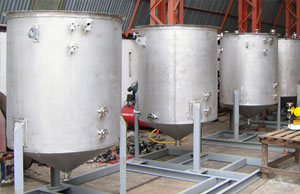
Vessels that are not pressurised, viz. used as storage purpose are manufactured as per standard procedure and tested for leakage before dispatch.
☼ Multi Media Filters
☼ Iron Removal Filters
☼ Micron Filters
☼ Activated Carbon Filters
☼ Chemical & Water storage Vessels
DE-IONISERS
Ion Exchange Method for Purification of WaterIon Exchange method is deployed to remove soluble impurities from water. The two major de-ionization applications are Softening and De-Mineralization.
The presence of Calcium, Magnesium salts (Cl-, SO4=, HCO3-, NO3- etc.) cause hardness in water. The process of removal of such salts using a stronger Cation (Na+) is known as Softening.
The other application, where the ions of dissolved salts get replaced by H+ and OH- ions to form pure water is known as De-Mineralization (DM). The process is initiated by application of chemicals, viz. Acid (for H+ cation) and Alkali (for OH- anion).
Softeners
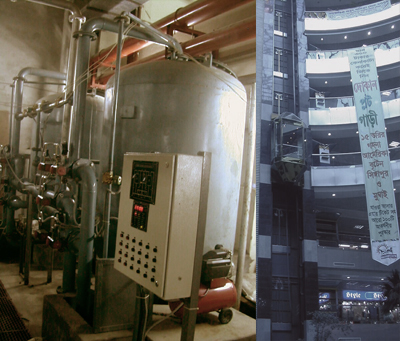
Removal of Ca & Mg salts (HCO3, Cl, SO4, NO3) which cause HARDNESS in water. Done by replacing Ca and Mg with Na by a Strong Cation Resin in Na+ form. To prevent scale formation in pipelines, boiler tubes & shell, other heat exchangers, cooling towers etc. HVAC, BF Water, Process water (for bleaching, dying, other chemical processes), Cooling tower make-up etc.
Done by cation exchange resin in Na+ form.
During service cycle the Na+ replaces Ca++, Mg++, Mn++ etc. the hardness causing cations. This process yields sodium salts as a end product of softening, hence TDS (Total Dissolved Solids) does not come down. Regeneration is done by passing brine solution through resin to recharge the sodium.
De-mineralisation (DM)
A treatment process that reduces the total salt content of water.
By conventional method - Ion Exchange Resins
By Membrane Separation - Reverse Osmosis Plants
With the help of cation (in H+ form) & anion (in OH- form) exchange resins.
Firstly the H+ replaces the cation part of the salts present. Next the OH- replaces the anion part of the ACIDS. Thus HOH i.e. water is formed. Hence in this process the TDS comes down to desired levels. After their respective cycles the cation & anion exchange resins are regenerated by using acid & alkali respectively.
Often used as a downstream process to Reverse Osmosis for additional polishing of water with lesser cost.
Applicable to
Textile, Food & Beverages, Pharmaceuticals, Power Plants, Electronics, Automobile, Process Industry etc..
MEMBRANES
Reverse Osmosis
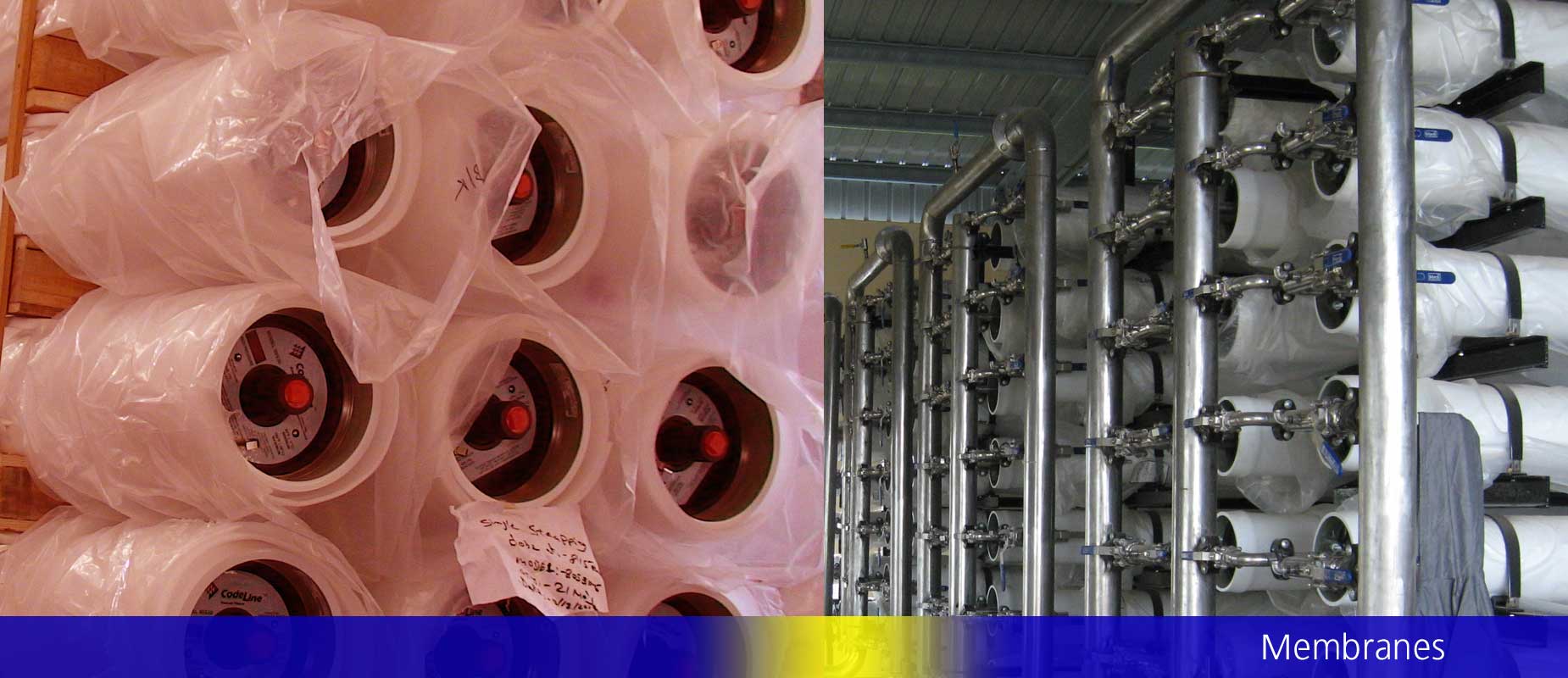
Reverse Osmosis or RO, is used to purify water by removing soluble impurities such as salts by passing the water through semi-permeable membranes. Using High Pressure pumps, the impure water is forced into RO Membranes, where the lower density part, viz. pure water get passed through the membrane while high density part i.e. impurities that can not pass through the membranes been collected as reject.
Another unique application of Reverse Osmosis where two sets of membranes are used one after another.
The concentrated Salt Solution or Reject is used to feed another set of Reverse Osmosis membranes. The process optimizes the output as well as requires lesser amount of filtered water as Feed.
Typical Reverse Osmosis application areas are Drinking Water, Pure Water Generation, Effluent Treatment etc.
In order to increase the life of RO Membranes, special care been taken for Pre-treatment of RO Feed water including Removal of Iron, Softening and Removal of all Oil Traces, Micro particles etc.
Ultra Filtration
Ultra Filtration is a tangential flow, pressure driven filtration process that separates particles on the basis of their molecular size. Pore diameters of Ultrafiltration membranes are in the range of 10 to 200 Å (0.02 to 0.001µ). Solvents and particles larger than 0.001µ gets filtered in this process. Solvents and species having a diameter smaller than the pore size of the membrane will pass through the membrane and emerge as ultrafiltrate known as permeate. Rejected species are progressively concentrated in the retained stream.
Ultra Filtration membranes are reusable and cleanable with standard chemicals.
Reverse Osmosis plays a big role in Desalination of Sea Water.
We source membranes from leading manufacturers of USA only.
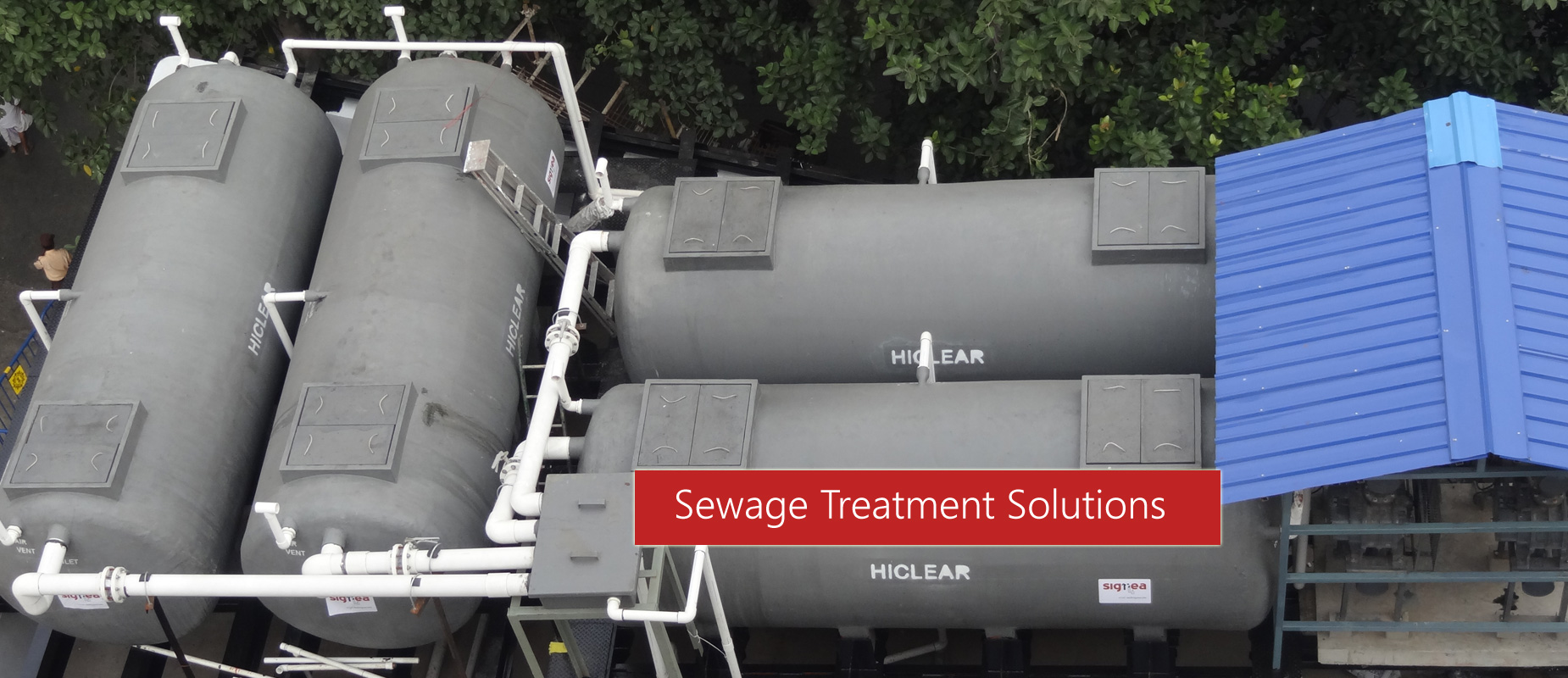
SEWAGE TREATMENT
A revolutionary idea in Domestic Sewage Treatment, HICLEAR Package Sewage Treatment plants are Clean and Environment friendly. Powered by biological treatment process by means of engineered bacteria, these plants do not need harmful and expensive chemicals to operate. Compact size, a little footprint and clean, odour free operation are the unique features of these plants.
The Fibre Reinforced Polymer (FRP) tanks come in sealed condition and require zero human intervention while running.
Green Solutions
✶ Modular & de-centralised Sewage Treatment Plants,✶ Lower piping cost as modular localized Plants help in avoiding sewerage transportation through busy & difficult locations,
✶ No need for RCC Tanks for STP process except the ones used for collection & equalization
✶ Biological Treatment ensures near to 100% digestion of sewage (i.e. no extra sludge removal required) leaving clear water to be discharged into environment or be used for gardening,
✶ Compact and closed chambers of STP ensures no foul odour or spillage of sewage in the vicinity,
✶ Treated water could be further treated to be used for many purposes including washing, flushing, cooling tower makeup etc.
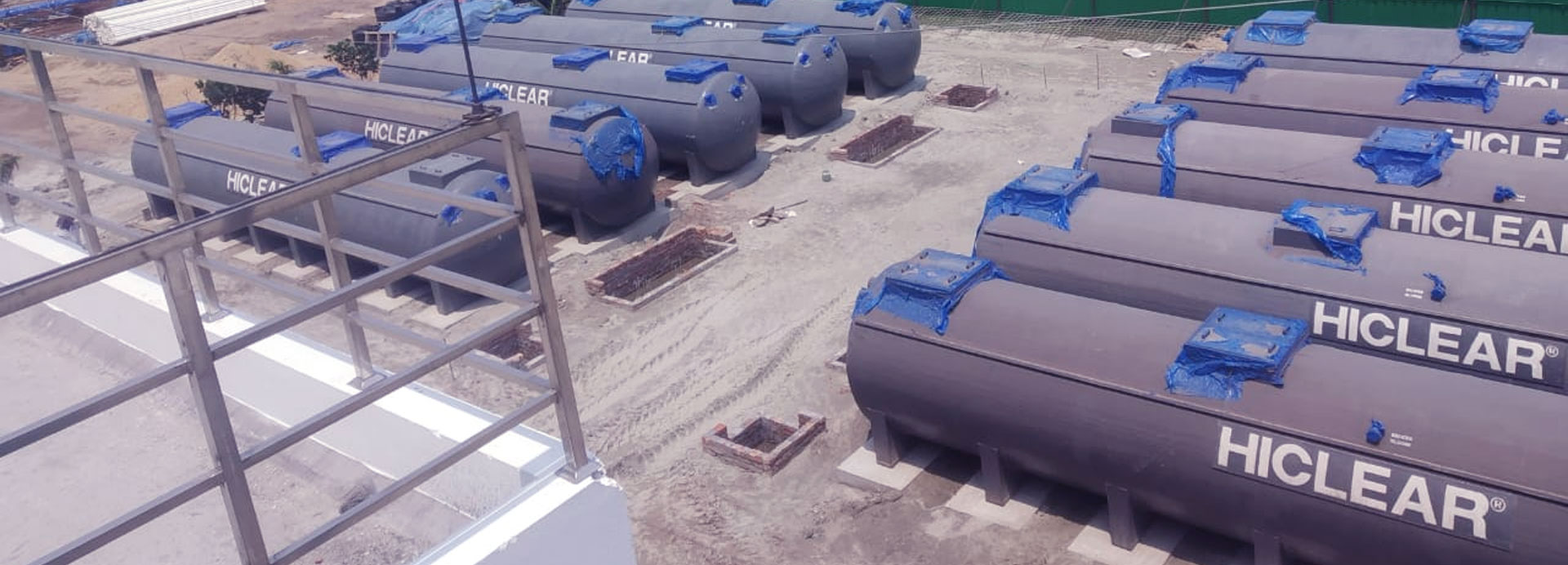
✶ Modular & de-centralised; Hence lesser pipeline for transportation; so lesser risk of failure,
✶ RCC tanks are rigid. FRP tanks can handle seismic shocks with better flexibility,
✶ Creating multi-storied RCC water tanks are probably a strict no-no in our line of business but with HICLEAR tanks; in situations of extremely tight land availabilities, double storied alignment is a definite possibility.
 Special Features...
✾ No Sludge handling,
✾ Lesser number of rotating equipments,
✾ No moving parts inside STP tanks,
✾ Lesser amount of Civil/ construction work involved,
✾ Minimal requirement of chemicals.
Membrane Bio-reactor (MBR)
Membrane based filtration system to purify wastewater. Once raw sewage attains a high MLSS level (about 8000-12000), passed through members to remove impurities. Output quality of MBR system is very high, that passes stringent Discharge Parameters set by environmental authorities across most countries.
Technical Details
■ Type of arrangement: Submerged■ Operating MLSS range: 8,000-12,000
■ Membrane MoC: PVDF
MBR Systems remove nutrients, suspended solids, E.Coli and other contaminants & various other living organisms from wastewater. Small pore sizes of membranes ensure very high clarity and significantly reduced pathogen concentration in treated sewage. MBR treated water is of enough high quality to be discharged into sensitive natural water bodies; also reclaimed for urban irrigation, utilities or toilet flushing.

MBR treated water can also be used as direct feed for Reverse Osmosis (RO) process. MBR is also effective at the biological removal of ammonia from sewage.
MBR Systems operated fully automated way. There are provisions of automatic ON/OFF of components like pumps and valves. They also act on System Feedback, like increased or decreased trans-membrane pressure, water level monitoring etc. while operating the system itself. High level of automation needs highly skilled operators. Thankfully, the robust automatic MBR Systems need operator interventions seldom.
Membranes need periodic cleaning. Once a week normal cleaning, and thorough chemical cleaning in about every three months.
